> Screens
> Overview
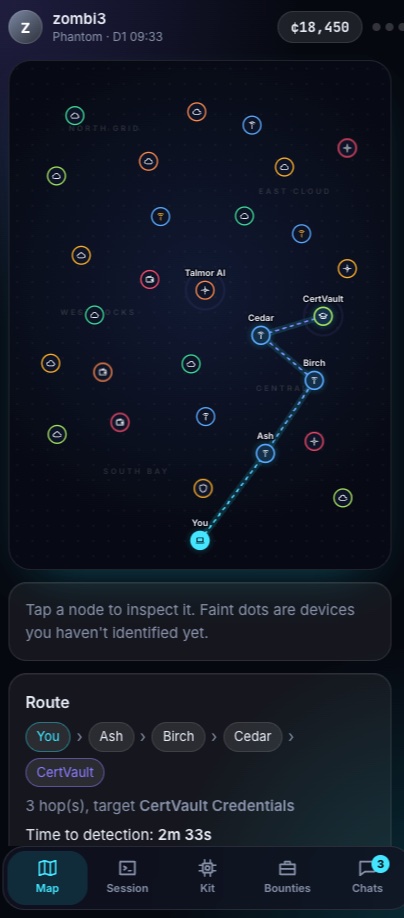
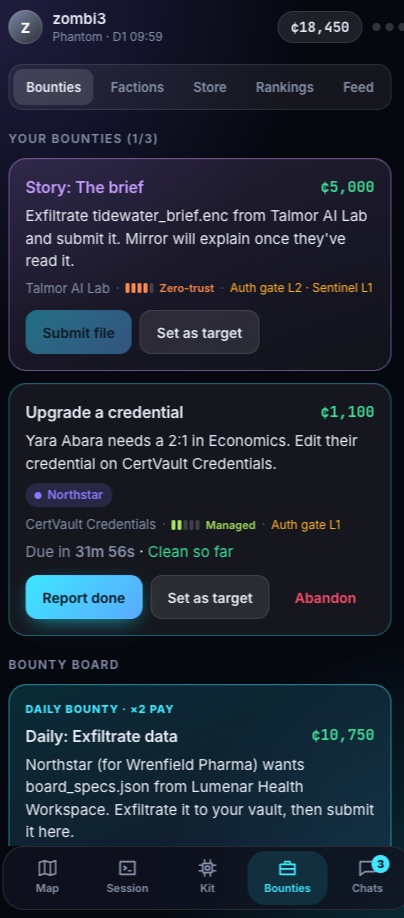
You are a contract hacker. Factions, companies and people with secrets post bounties: steal a file, wipe a record, upgrade someone's credentials, clean a background check, move money between wallets. You pick the job, plan a route through hijacked smart cameras, home routers and cloud VMs, get in, do the work, wipe your telemetry and get out. Every hop you add buys time before security notices you.
It is my take on the classic freelance hacker sim, rebuilt for a phone and set in the present day. Every name, line of text, sound and visual in it is original.
> How a bounty plays
- Route. Chain hops on the map. Hops get hot with use and cool down over time, and private proxies charge a fee
- Detection. A meter runs Anomaly, Alert, Incident. Hit 100% and you are disconnected
- Defences. Auth gates block an admin session until you open them, and sentinels speed detection up until you mute them
- Threat hunts. Leave telemetry behind and a security team works back along your route, one hop at a time. Three strikes and you are burned
- Kit. Five tools and three hardware upgrades, each changing the maths of a job rather than just a number on a screen
> Factions and story
Every bounty is really posted by one of three factions: hacktivists, a syndicate and a corporate intelligence firm. Working for one annoys its rival, and standing unlocks perks or closes doors. On top of the endless procedural board there is a Daily Bounty at double pay with a streak bonus, and three story arcs that each end in a choice. The choices change the world afterwards, and the last arc has a proper ending.
> How it is built
Plain ES modules, no framework and no build step, around 3,300 lines. The rules live in one module with no DOM in it, so the whole game can be played headlessly in Node: the test drives the tutorial, the factions, all three story arcs and getting burned, and checks the state after each step. The UI re-renders from state and patches only the fast-moving parts like the detection meter. Sound is generated with Web Audio rather than shipped as files. Capacitor wraps it as a native iOS app with haptics, and it is running on my phone now.
> Status
Playable start to finish. Next is TestFlight, then the App Store.